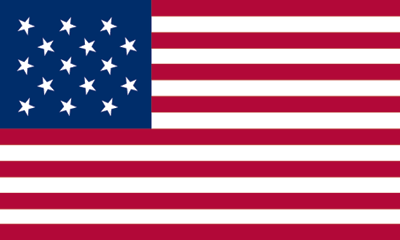
Star Spangled Banner or
Fort McHenry Flag or 15 Star, 15 Stripe Flag-1794
During January of 1794, heated debate arose on the floor of congress. The issue was whether the Flag of the United States should be altered to include the two states added to the union since 1777. Some stated the Flag was static and could not be changed. Others insisted it was up to the individual states to decide if they wanted to be included on the Flag. In the end, congress passed the Flag Act of 1794 stating the Flag of the United States would be 15 alternating red and white stripes with a union of 15 stars. Despite states continuing to join the Union, the 15 Star/15 Stripe Flag remained the official Flag of the United States until 1818.
The 15 Star/15 Stripe Flag was the official American Flag when the War of 1812 broke out. In 1813, Major George Armistead took command of Fort McHenry, guarding the entrance to Baltimore Harbor. Armistead commissioned two Flags from Baltimore seamstress Mary Pickersgill, an enormous garrison flag and a smaller storm flag. She was assisted by her African American apprentice, Grace Wisher, Mary’s daughter, mother, and two nieces. Over the course of two months, the team worked late into the night, using the floor of a local brewery to accommodate the of the size of the garrison flag.
After burning Washington D.C. in August of 1814, the British moved on to Baltimore. Failing to take the city by land, the British attempted to come through the harbor.
On the way to Baltimore, the British had taken hostage Maryland Doctor, William Beanes. Under a flag of truce, Francis Scott Key sailed out to the British Fleet amassed outside Baltimore harbor to negotiate Beanes’ release. Negotiations were successful, but Key was detained by the British so as not to tip off the Americans.
The morning of 13 September 1814, British warships unleashed a devastating bombardment on Fort McHenry lasting 25 hours. Throughout the dark and stormy night, Key could see in the red glow of the rockets the small storm flag. The following morning, by dawn’s early light, he saw the huge garrison flag made by Mary Pickersgill and Grace Wisher waving over the fort. The British attempt to take Baltimore had failed. The event inspired Key to write the poem “The Defense of Fort McHenry”, which was put to music and became known as the “Star Spangled Banner”.
The large Flag which inspired Key was passed down generationally in the Armistead family and donated to the Smithsonian Institute in 1912. It is on permanent display at the Smithsonian.
Sources include:
Canby, George. “The Evolution of the American Flag” pp. 87-89, (1909) Ferris & Leach
Flag Act, 166, 3rd Cong., 1st Sess. (1794) (enacted)
Follows, Samuel. “Story of the American Flag” pp. 55-59, (1908) Educational Publishing Company
Founders Online. “The Flag, [7 January] 1794,” National Archives, Original source: The Papers of James Madison, vol. 15, 24 March 1793 – 20 April 1795, https://founders.archives.gov/documents/Madison/01-15-02-0112.
Furlong, William and McCandless, Byron “So Proudly We Hail, The History of the United States Flag” p. 158, 173-174 (1981) Smithsonian Institution Press
Indenture of Grace Wisher. 1809. United States Daughters of 1812 http://www.flaghouse.org/wp-content/uploads/2021/02/One-Minute-History-4-Grace-Wisher.pdf
National Parks Service. “Fort McHenry, The Garrison Flag” Retrieved 21 July 2024 from https://www.nps.gov/fomc/learn/historyculture/the-great-garrison-flag.htm
National Parks Service. “Grace Wisher” Retrieved 30 July 2024 from https://www.nps.gov/fomc/learn/historyculture/grace-wisher.htm
Preble, George. “Our Flag, Origin and Progress of the Flag of the United States of America” pp. 221-223, (1872) Kessinger’s Legacy Reprint
Purdy, Caroline. “Letter to Georgaina Armstead Appleton” (1876) Retrieved 19 November 2023 from https://amhistory.si.edu/starspangledbanner/pdf/Caroline%20Purdy%20Letter%20transcript.pdf
Receipt for the Star-Spangled Banner. 1813. http://www.users.interport.net/s/s/ssbfh/receipts.html
The Star-Spangled Banner Project. “Three Cheers for the Red, White, and Blue, Star-Spangled Banner” National Museum of American History, Smithsonian Institution. Retrieved 21 July 2024 from https://www.si.edu/spotlight/flag-day/banner-facts