Memorial Day
or
Decoration Day
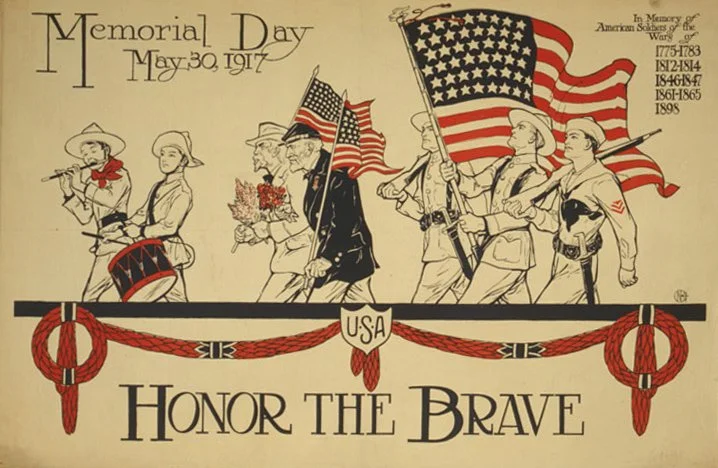
Honor the Brave Memorial Day, May 30, 1917. Poster, 1917. //hdl.loc.gov/loc.pnp/cph.3g08122
The Civil War, which took about 2% of the population, was the most devastating event in U.S. history. There were so many dead that the federal government had to establish national cemeteries to bury them. Many towns claim to have started Decoration Day by decorating the graves of fallen soldiers. In May of 1865, thousands of freed slaves gathered at an abandoned prison camp in Charleston, South Carolina, where 257 Union soldiers were buried in unmarked graves. They sang hymns, spread flowers, and listened to sermons given by black and white pastors.
General John Logan, leader of a large veterans' group, declared the first national Decoration Day on May 30, 1868. A day in late spring was chosen because of the availability of flowers. The first ceremony at Arlington National Cemetery was held that year, dedicated to prayer, singing hymns, and decorating Union and Confederate graves alike. A sermon was given by pastor, general, and future president, James Garfield. Sometimes called the "Great War", WWI ravaged Europe and the Middle East. Of the 4 million Americans who helped end the war, more than 100,000 gave their lives. After the war, Decoration Day was expanded to include all who made the ultimate sacrifice.
New York became the first state to make Decoration Day a holiday in 1873. In 1888, federal employees were granted the holiday. Passage of the National Uniform Monday Holiday Act in 1968 moved the day to the last Monday in May and changed the name to Memorial Day.