Easter Sunday
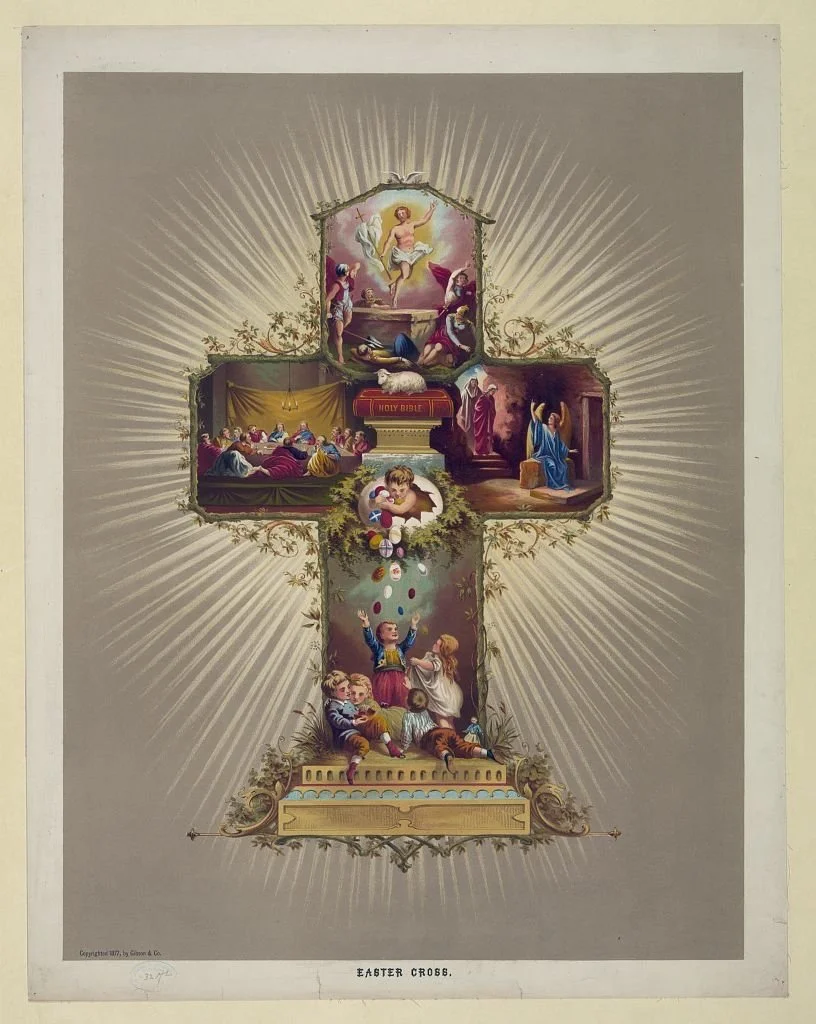
Easter Cross. , ca. 1877. Photograph. https://www.loc.gov/item/95505388/.
In colonial North America, Easter observances varied. Spanish colonist spent most of the week before Easter in church praying and the week after celebrating. For the French, a huge party called Mardi Gras was followed by Lent, a month and a half of prayer and fasting before Easter. Pennsylvania Quakers, who liked to keep things simple, kept Easter simple. Living in constant fear of happiness, New England Puritan preachers intentionally avoided the subject of Christ’s resurrection on Easter Sunday.
German immigrants brought traditions of an egg-laying bunny and coloring Easter eggs. Children of German immigrants made nest for the Easter Hare to leave brightly colored eggs and sometimes chocolates. Eventually, more portable baskets replaced nests. Some time during the early 1800’s, they began pressing chocolate into egg and bunny shapes.
Following the American Revolution, Easter was mostly a quiet, religious observance, spent going to church and having dinner with the family. In early Spring, ham cured the previous fall was often the only meat available, so it became the traditional American Easter dinner meat. Like many American holidays, Easter traditions began to take shape in the 19th century.
Easter egg rolling, pushing eggs through the grass with long handled spoons, became popular in the early 1800’s. Dolly Madison first suggested a public egg roll at the White House and the Lincoln’s held Easter picnics on the grounds during the 1860’s. In 1878, President Hayes made the Easter egg roll an annual White House tradition. In 1889 President Harrison added music with a concert by the Marine Corps Band. In 1969, the Easter Bunny became part of the annual festivities. A closely guarded state secret, the Easter Bunny is always played by a member of the First Lady’s staff.
During the 1800’s dyeing eggs became popular nationwide using onion skins and other commonly available ingredients. New Jersey pharmacist William Townly came up with a formula for consecrated dye and in 1881 started what would become the PAAS Dye Company. The company name coming from the Dutch word for Easter.
Easter lilies were introduced to America in 1880. The coastal region of Northern California and Oregon has become the Easter Lily Capitol of the World. Reminding us of the One who made the lame walk, the blind see and elevated the status of children, the Easter Seals Society, founded in 1919, took the Easter Lily as their symbol.
Passed by Congress in 1924, the Flag Code recognizes Easter Sunday as an appropriate day to display the Flag. Falling on Sunday, most federal offices are closed, so Easter is not a federal holiday. However, it is an important day filled with many great American traditions.