Roger Williams and
America’s First Flag Controversy
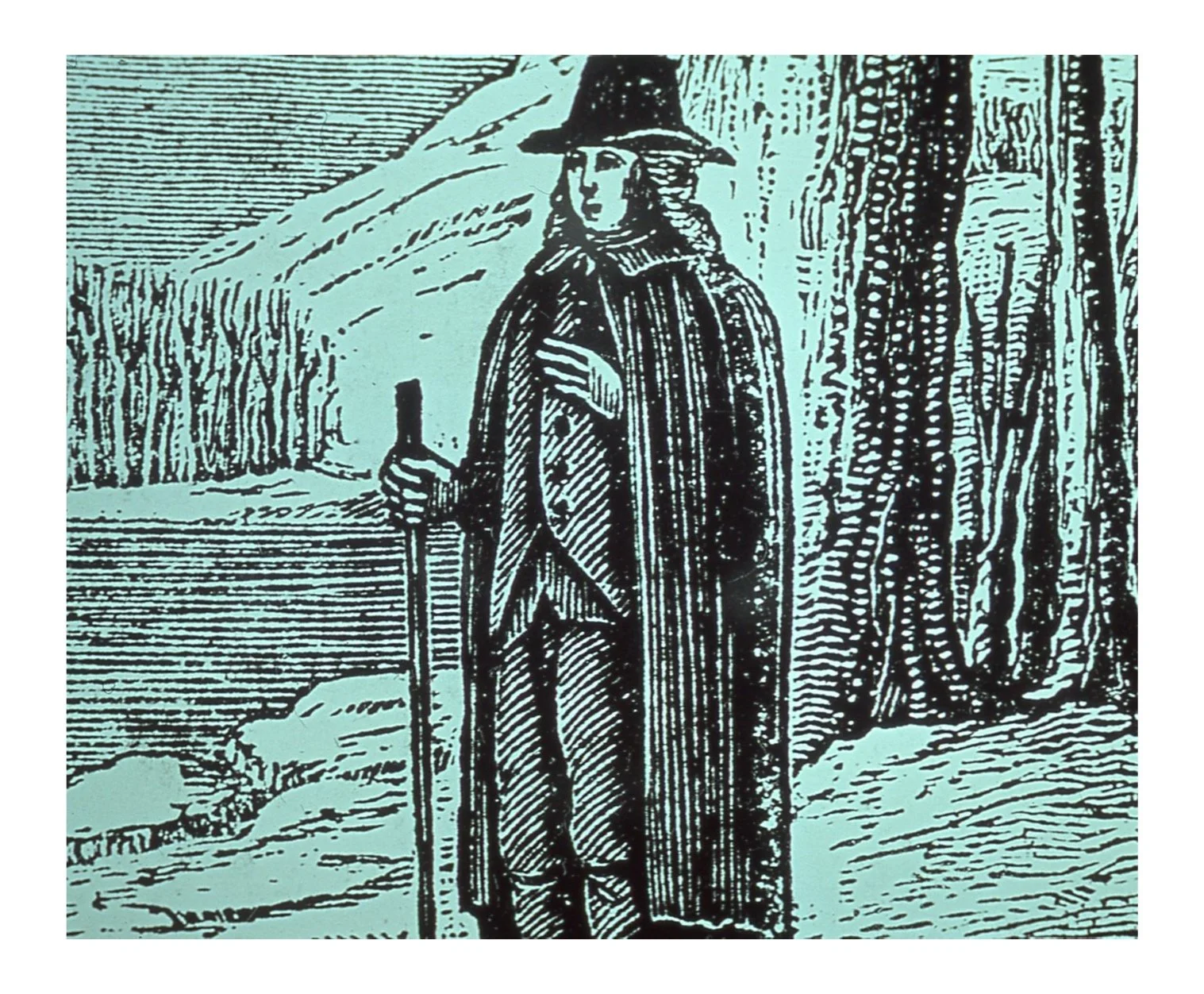
Roger Williams Woodcutting
National Parks Sevice
It has been suggested, religion in 16th century England was so volatile the English would burn Catholics at the stake in the morning and Protestants in the afternoon. King Henry VIII split with the Catholic Church in 1534 and subsequent monarchs seesawed between Catholicism and Protestantism. When Henry’s oldest daughter, a devout Catholic came to the throne, she unleashed a purging of protestants which earned her the nickname Bloody Mary. Upon her death, Elizabeth I, became Queen. Hopeful protestants who had fled to Europe returned to England, bringing Calvinism with them. England was torn between Catholicism, Anglicanism, and Calvinism. In the early 1600’s, religious decenters began making their way to North America and establishing colonies where they could worship as they saw fit. Unfortunately, governments of these colonies were often as intolerant of varying religious views as had been the monarch.
It was into this religious and political quagmire Calvinist minister Roger Williams began his ministry. Ordained in the Church of England, Williams found himself aligning with Puritan views. He took a position as family chaplain for a prominent parliamentarian which brought him into contact with Puritan leaders. Believing the Puritans weren’t going far enough to purify the Church of England, Williams came to embrace Separatist views and immigrated to Massachusetts in 1631.
Rejecting a pastoral position in Boston, he instead accepted John Endecott’s offer to join the teaching team in Salem. After clashing with the Puritans of Salem, Williams relocated to the Separatist colony of Plymouth. There he did a little preaching, a little farming, and a little trading with the Wampanoag people. Williams learned their language and cultivated a friendship with the Great Chief Massasoit. After a couple years, he rejoined the teaching team in Salem.
Williams saw the Cross of Saint George on the King’s flag as a symbol of a Catholic saint, therefore sign of Catholicism and idolatry. Acting under the influence of Williams, in the fall of 1634, Salem militia commander John Endicott cut the Saint George’s Cross from the militia’s flag. In his journal, Puritan leader John Winthrop recorded the chain of events this action set in motion. New England Puritans did not want to be seen as supporting Catholicism. Neither did they want to appear to be in revolt against the king. The Puritan leaders met repeatedly attempting to find a solution. Controversy over the flag divided the colony and for a time, no flag was flown. In December of 1635, a military commission approved a flag replacing the Saint George’s with the king’s coat of arms. After further controversy, the King’s flag once again flew over the fort grading the entrance to Boston Harbor. Local militias flew flags of their own choosing.
For his part in the uproar, John Endicott was forbidden to hold public office for one year. Roger Williams would eventually be banished from Massachusetts and go on to found Rhode Island, a colony known for its religious tolerance.
Sources:
Bremer, Francis. “Endicott and the Red Cross: Puritan Iconoclasm in the New World” (April 1990) Cambridge Press
Library of Congress. “Roger Williams, Rhode Island Founder” Retrieved 5 February 2023 from https://www.loc.gov/item/today-in-history/february-05
Grefe, Morgan. “Roger Williams and the Founding of Rhode Island” EnCompass Retrieved 4 March 2023 from http://library.providence.edu/encompass/roger-williams-and-the-founding-of-rhode-island/roger-williams-and-the-founding-of-rhode-island/
Preble, George. “Our Flag, Origin and Progress of the Flag of the United States of America” pp. 120-122, (1872) Kessinger’s Legacy Reprint
Winthrop, John. “Winthrop’s Journal, History of New England, 1630-1649, Vol 1” pp. 137, 147, 174, 181,182 (1908) Charles Scribner Son’s