Samuel Forster and Corresponding Flag
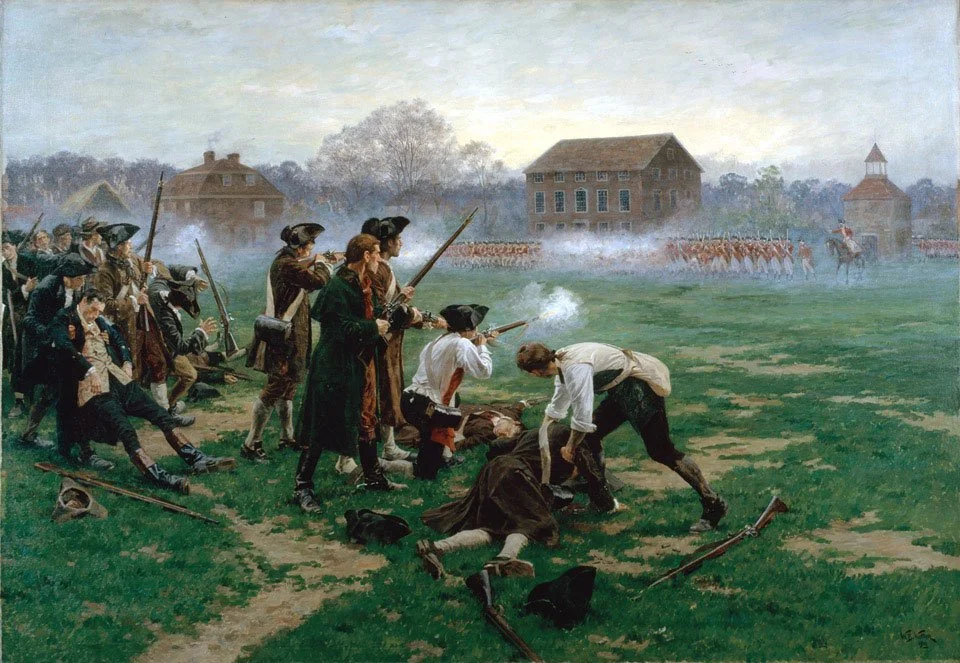
The Battle of Lexington, 19April1775
Oil on canvas by William Barns Wollen
National Army Museum
Committees of correspondence provided a means of communication for colonial legislatures from the early 1700’s. As tensions between Great Britain and the colonies grew, committees were organized in many towns and villages. Committees shared information, confirmed mutual support, and organized resistance. Samuel Forster was elected to the Manchester Massachusetts Committee of Correspondence in 1775.
In the fall of 1774 General Thomas Gage, the royal governor of Massachusetts, dismissed the colony’s representative legislator. The group reconvened in Salem and voted to strengthen colonial militias. Forster was made 1st LT of the Manchester Company, Essex County Regiment.
Early on the morning of April 19th, 1775, word reached Manchester that British troops had marched on the towns of Lexington and Concord. LT Forster and his company began marching to join the battle, carrying their red flag, with 13 white stripes.
By the time the company reached Medford, 10 miles from Lexington, the British were in headlong retreat. Some of the company joined in chasing the British back to Boston. LT Forster returned to Manchester to help prepare against possible attack. He kept the Forster Flag with him, and it remained a cherished family heirloom for generations.
Sources
American Battlefield Trust. “Lexington and Concord” Retrieved 27 April 2023 from https://www.battlefields.org/learn/revolutionary-war/battles/lexington-and-concord
Smith, Whitney. “The Forster Flag, The First American Flag Ever Made” The Flag Bulletin pp.82-118 (May/June 2002)
Treesh, Catharine. “Committees of Correspondence” Washington Library, Digital Encyclopedia. Retrieved 29 April 2023 from https://www.mountvernon.org/library/digitalhistory/digital-encyclopedia/article/committees-of-correspondence/#:~:text=Committees%20of%20correspondence%20were%20longstanding,their%20own%20committees%20of%20correspondence.