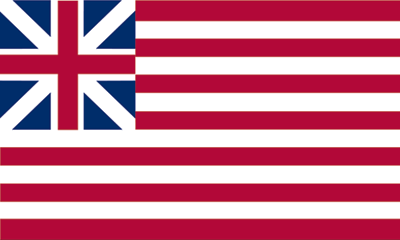
Grand Union or Continental Colors or Flag of the United Colonies-December 1775
As 1775 drew to a close, British colonists in the 13 American colonies were divided. Some believed separation from Britain to be the only way to guarantee their rights. Others saw living as second-class citizens of the empire preferable to the hardships of starting a new country. In either event, it was apparent the current conflict with Great Britain would be lengthy. The newly organized Continental Army and Navy needed a method of identifying their ships and forces from a distance.
Although British East India Company ships never sailed in American waters, their influence impacted the 13 colonies. When Parliament passed the Tea Act of 1773, giving the company a monopoly in tea sales, colonists were outraged. British East India Company ships sailed under ensigns with varying numbers of red and white stripes featuring the British Union in the upper corner. Similarities between the United Colonies’ Grand Union and the East India Company’s ensign were likely coincidental, as a Grand Union could be easily made by sewing six white stripes onto a British Red Ensign.
Controversy continues over the maker and first raising of the Grand Union. John Adams insisted the Grand Union was raised in November 1775 by Capt. John Manley of Massachusetts over a captured British ship. John Paul Jones, then a lieutenant on the Continental Ship Alfred, wrote in his journal that in December 1775 “My hand first hoisted the American Flag.” Although he does not give a description of the Flag or an exact date, many historians give Jones credit for raising the first Grand Union. Records show charges to the Alfred’s account for material provided to Philadelphia milliner Margaret Manning in early December 1775, likely used to make the Flag.
No original Grand Union Flag is known to exist. However, a significant number of journals and letters indicate its use throughout 1776. A sketch found among the papers of Gen. Philip Schuyler of the schooner Royal Savage, in use during 1776, displays a Grand Union flying from the main mast.
In a letter written a century later, Caroline Pickersgill Purdy stated her grandmother, “Rebecca Young, made the first Flag of the revolution, under George Washington’s direction.” Many historians believe this is the same Flag mentioned by Washington in a 4 January 1776 letter to Col. Joseph Reed. Washington reports that in recognition of the reorganized Continental Army “We raised a Union Flag in compliment to the United Colonies.” He also mentions a person coming out of British occupied Boston claimed, the flying of a Flag which included the British Union was taken as a sign surrender. As the 13 colonies moved towards Independence, it became apparent an entirely new Flag was needed.
For more information, please consult the following sources:
Balderston, Marion. “The Flag John Paul Jones Really Fought Under” (1969) Library Quarterly 33, no. 1 pp. 77–83. https://doi.org/10.2307/3817016
Canby, George. “The Evolution of the American Flag” pp. 17-23, (1909) Ferris & Leach
Follows, Samuel. “Story of the American Flag” pp. 11-13, (1908) Educational Publishing Company
Furlong, William and McCandles, Byron. “So Proudly We Hail, The History of the United States Flag” p. 89, (1981) Smithsonian Institution Press
Preble, George. “Our Flag, Origin and Progress of the Flag of the United States of America” pp. 152-1787, (1872) Kessinger’s Legacy Reprint
Purdy, Caroline “Letter to Georgaina Armstead Appleton” (1876) Retrieved 19 November 2023 from https://amhistory.si.edu/starspangledbanner/pdf/Caroline%20Purdy%20Letter%20transcript.pdf
Hamilton, Schuyler. “The History of the National Flag of the United States of America” pp. 53-72, (1852) Scholar Select
Washington, George “Letter to Col Joseph Reed” (January 1776) Retrieved 18 Nov. 2023 from https://founders.archives.gov/documents/Washington/03-03-02-0016
Rebecca Flower Young
Generations of Flag Making
On the 1st of January, General George Washington raised a Flag having 13 red and white stripes and the British Union in the upper corner. Some historians believe this Grand Union Flag was created by Rebecca Flower Young of Philadelphia.
Rebecca Flower, the daughter of a merchant seaman, was born into a well-connected Philadelphia family. She moved in circles which included Signer of the Declaration Dr. Benjiman Rush and Continental supply officer Major Jonathan Gostelowe. Rebecca married William Young in 1762. The family was forced to flee Philadelphia in 1777 while the British briefly occupied the city. When William died of camp fever in 1778, Rebecca was left to raise their five children alone.
Rebbeca’s brother, Col. Benjamin Flower, found her a house in Philadelphia and helped her secure contracts to make supplies for the Continental Army, including Flags. Records indicate she provided supplies for the military through 1788. She had a successful Flag making business and advertised extensively.
Rebecca Young moved to Baltimore and in 1813 helped her daughter, Mary Young Pickersgill, make two Flags for Fort McHenry. Seeing these Flags flying fly though the bombardment of Fort McHenry inspired Francis Scott Key to write what would become the lyrics to the National Anthem.
Sources:
Calash, Kitty “To Philadelphia Again” Confessions of a Known Bonnet-Wearer (blog) 12 April 2019. https://kittycalash.com/2019/04/12/to-philadelphia-again/
DeLear, Byron "Revisiting the Flag at Prospect Hill: Grand Union or Just British?" (2014). Raven: A Journal of Vexillology. 21: 19–70.
Flower, Benjiman “Letter to Rebbecca Young” (July 1778) Retrieved 27 July 2026 from https://collections.digitalmaryland.org/digital/collection/fhcl/id/9/rec/1
Furlong, William Rea; McCandless, Byron “So Proudly We Hail: The History of the United States Flag” pp. 135-137(1981) Washington, D.C.: Smithsonian Institution Press
Purdy, Caroline “Letter to Georgaina Armstead Appleton” (1876) Retrieved 19 November 2023 from https://amhistory.si.edu/starspangledbanner/pdf/Caroline%20Purdy%20Letter%20transcript.pdf
United States Daughters of 1812 “A Minute in History at the Star-Spangled Banner Flag House #1 Rebecca Flower Young” Star-Spangled Banner Flag House Association; Retrieved 26 July 2026 from https://flaghouse.org/wp-content/uploads/2020/03/One-Minute-History-1-Rebecca-Young.pdf
WikiTree “Benjamin Flower” Retrieved 6 August 2026 from https://www.wikitree.com/wiki/Flower-2132
Young, Rebecca (1781) (Advertisement for Colours) Pennsylvania Packet
https://timeline.amrevmuseum.org/objects/rebecca-flower-young-ad