
Betsy Ross Flag-June 1776
As the United Colonies moved towards independence, it became apparent the Grand Union Flag, then in common use, was inappropriate for the new nation. General Washington had written about the confusion caused by the Grand Union when flown over his camp at Cambridge.
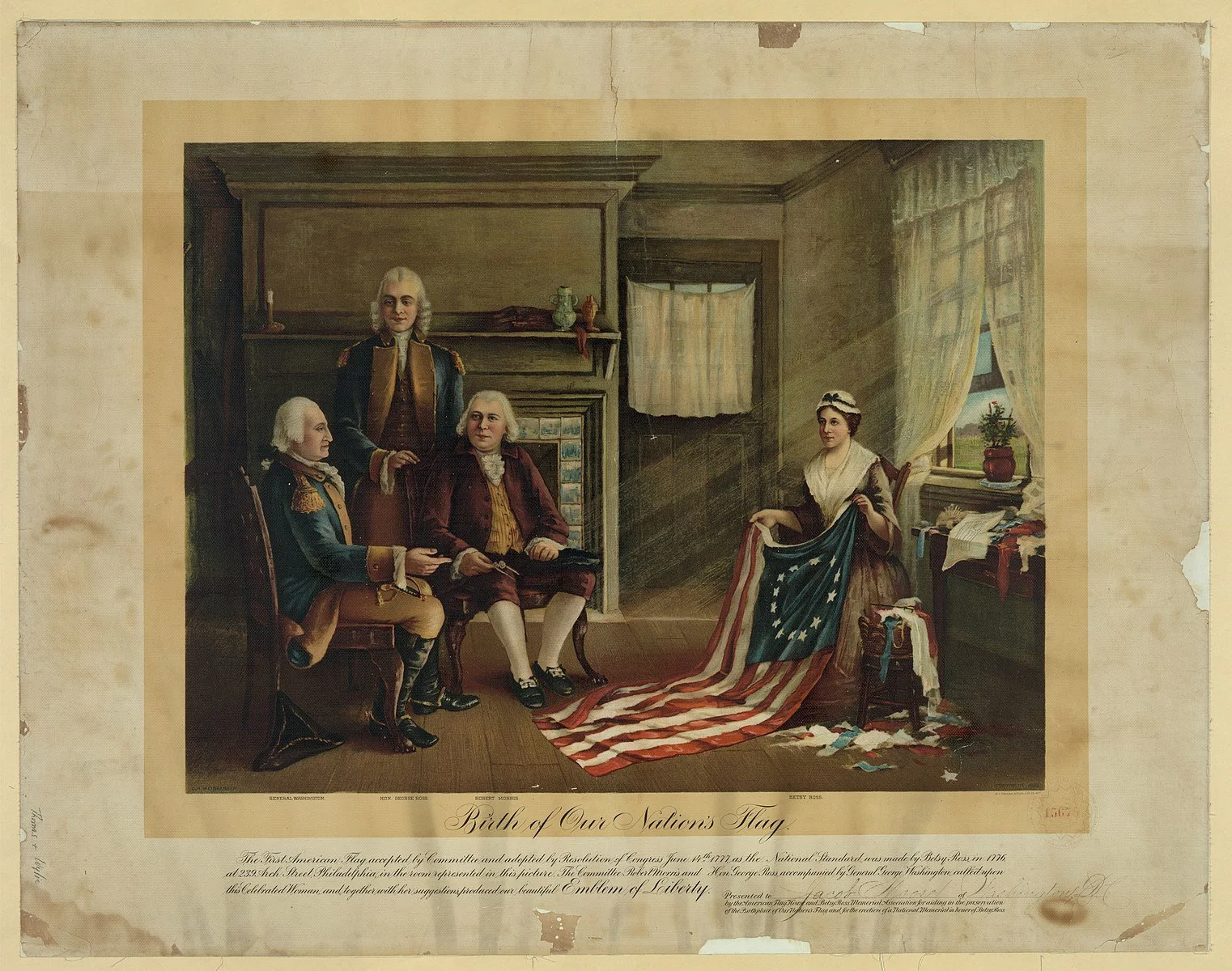
In the spring of 1776, General Washington was summoned to testify before congress. While in Philadelphia, Washington, along with two members of congress, visited Gold Star Widow and upholster, Betsy Ross. Betsy and her late husband, John, had made bed linens for the Washingtons, and their pew at Christ Church was adjacent the Washingtons’ pew. After the start of the American Revolution, John Ross joined the army and in January of 1776, died when the ammunition supply he was guarding exploded.
Legend has it, Washington provided a sketch of a Flag with 13 alternating red and white stripes and a union of blue with 13 white, 6-point stars. Betsy suggested 5-point stars would be more efficient and produced a prototype for the Flag which a year later became the official Flag of the United States of America. (Read more about Betsy Ross below.)
No original of the Flag attributed to Betsy Ross is known to exist. The pattern bearing her name, 13 stars arranged in a circle, does appear in William Barton’s 1782 design suggestion for the Great Seal of the United States and Charles Pale’s 1779 painting “George Washington at Princeton.” The Betsy Ross Flag also appears in John Trumbull’s “George Washington before the Battle of Trenton.” Trumbull received guidance for the painting from a most reliable source, George Washington.
While there is no conclusive evidence Betsy Ross made the first American Flag, much circumstantial evidence points to her. In 1952 the Postal Service issued a stamp honoring Betsy Ross for making the first American Flag. So, if the U.S. Postal Service, an agency of the federal government, considers Betsy Ross the maker of the first American Flag, she must therefore be the maker of the first American Flag.
For more information, please consult the following sources:
Barton, William. “Great Seal Design” (1782) National Archives
Boggs, Margaret. “Affidavit Dated 3 June 1870” Philadelphia, PA. Retrieved 20 Jan 2023 from https://www.ushistory.org/betsy/flagaffs3.html
Canby, George. “The Evolution of the American Flag” pp. 36-52, (1909) Ferris & Leach
Christ Church Philadelphia. “Our History and our People, Notable Attendees”. Retrieved 20 Jan 2023 from https://christchurchphila.org/history/
Couder, Auguste. "Siege of Yorktown (1781)." World History Encyclopedia. Last modified February 21, 2022. https://www.worldhistory.org/image/15268/siege-of-yorktown-1781/
Fletcher, Rachal. “Affidavit Dated 31 July 1871” New York, NY. Retrieved 20 Jan 2023 from https://www.ushistory.org/betsy/flagaffs.html
Furlong, William and McCandless, Byron “So Proudly We Hail, The History of the United States Flag” pp.138-139 (1981) Smithsonian Institution Press
Hamilton, Schuyler. “The History of the National Flag of the United States of America” pp. 101-108, (1852) Scholar Select
Hildebrandt, Sophia. “Affidavit Dated 27 May 1870” Philadelphia PA. Retrieved 20 Jan 2023 from https://www.ushistory.org/betsy/flagaffs2.html
Isaac, Amanda. “Furnishings of the Chintz Room” (2016) George Washington’s Mount Vernon. Retrieved 19 January 2024 from https://www.mountvernon.org/the-estate-gardens/the-mansion/the-chintz-room/furnishings/#:~:text=Washington%20acquired%20a%20set%20of,period%20set%20of%20English%20chairs.&text=The%20bedstead%20and%20bedding%20in,have%20been%20somewhat%20newer%20additions.
Independence Hall Association. “A Brief Biography of Betsy Ross.” Retrieved 22 January 2024 from https://www.ushistory.org/betsy/flaglife.html
Peale, Charles “George Washington at Princeton” (1779) Pennsylvania Academy of the Fine Arts
Preble, George. “Our Flag, Origin and Progress of the Flag of the United States of America” pp. 192-197, (1872) Kessinger’s Legacy Reprint
Smith, Whitney. “The Flag Book of the United State” pp. 54-55 (1970) William Marrow and Company Inc.
Smithsonian National Postal Museum. “Women on Stamps, Betsy Ross”. Retrieved 23 January 2024 from https://postalmuseum.si.edu/exhibition/women-on-stamps-part-1-forming-the-nation-pioneering-women/betsy-ross#:~:text=The%203%2Dcent%20Betsy%20Ross,founding%20of%20the%20new%20nation.
Trumbull, John. “George Washington before the Battle of Trenton” (1794) Oil on canvas. The Metropolitan Museum of Art https://www.metmuseum.org/art/collection/search/12823
Washington, George “Letter to Col Joseph Reed” (January 1776) Retrieved 18 Nov. 2023 from https://founders.archives.gov/documents/Washington/03-03-02-0016
Before Rosie the Riveter was an Icon, Betsy Ross was a Super Star
Born on New Year’s Day 1752 in the New Jersey, Elizabeth “Betsy” Griscom grew up in a large, strict, Quaker family. At the age of three, the family moved to Philadelphia. Believing all people were created in the Image of God, Quaker education was centuries ahead of its time. So, Betsy received something girls in other colonies often didn’t, an education. Being a talented seamstress, she also received an opportunity few young women at that time had, the opportunity to learn a trade.
Betsy was apprenticed to an upholsterer. While serving her apprenticeship, she met and fell in love with John Ross, an Anglican. Her family did not approve. The couple ran off to New Jersey and were married in a tavern in 1773. They settled in Philadelphia and began attending Christ Church, which put them into contact with the members of the Continental Congress. Shunned by Philadelphia’s Quaker community, the Ross’s struggled to establish their upholstery business. However, they were able to develop a customer base which included Martha and George Washington. When war came, John Ross went off to serve with the Pennsylvania Militia. He was killed in an explosion while guarding an ammunition supply.
As a young widow, Betsy managed to keep the upholstery shop going by making materials for the Continental Army. In the spring of 1776, her business got an unexpected boost. A committee of three, including her late husband’s uncle and a friend from church, George Washington, showed up at her shop. They brought a design for a new Flag. She made a couple alterations and created a prototype for the American Flag. In May of 1777, Betsy was paid to make flags for the Pennsylvania Navy. She continued making flags for decades.
In June of 1777, Betsy married merchant sea captain Joseph Ashburn. In October of that year, the British occupied Philadelphia, and Betsy was forced to quarter British soldiers. So great was her displeasure with this, she became known as the Little Rebel. On a privateering mission, Ashburn was captured by the British and imprisoned. Dying in prison, Ashburn asked fellow prisoner, privateer John Claypoole, to seek out Betsy when he returned to Philadelphia.
John Claypoole, the son of a Philadelphia tanner, broke with his pacifist Quaker upbringing to take up arms in the cause of Liberty. He became a part of the Free Quaker sect which Betsy had also joined. While doing a bit of privateering, he was captured and imprisoned, where he met the dying, Joseph Ashburn. After the war, Claypoole returned to Philadelphia bringing the sad news to Betsy. The two rekindled an old friendship and were married. The couple enjoyed 34 years of marriage and had five daughters.
The story of Betsy Ross first surfaced in an 1870 speech by her grandson to the Pennsylvania Historical Society. She quickly became an American icon at a time when there were few women icons. Her likeness was used to sell everything from coffee to cigars, and her name was evoked by the Women’s Suffrage movement. Her face was on even on an early type of trading card. To this day, Betsy Ross is the best known of the Founding Mothers.
To learn more about this amazing lady, please consult the following sources:
Alexander, Kerri Lee. "Betsy Ross." National Women's History Museum (2019) www.womenshistory.org/education-resources/biographies/betsy-ross.
American Battlefield Trust. “Betsy Ross” Retrieved 23 January 2024 from https://www.battlefields.org/learn/biographies/betsy-ross
Betsy Ross House “The Upholstery Shop” Historic Philadelphia Retrieved 3 February 2024 from https://historicphiladelphia.org/stories/the-upholstery-shop/
Canby, George. “The Evolution of the American Flag” pp. 36-52, (1909) Ferris & Leach
Canby, George. “The History of the Flag of the United States” (1870) A Paper read before the Historical Society of Pennsylvania.
Claypoole, John. “To George Washington from John Claypoole, 4 September 1790,” Founders Online, National Archives, https://founders.archives.gov/documents/Washington/05-06-02-0188.
Daughters of the American Revolution. “Pathway of Our Patriots, Elizbeth Griscom Claypoole” Retrieved 3 February 2024 from https://honoringourpatriots.dar.org/patriots/elias-cady-2/
Furlong, William and McCandless, Byron “So Proudly We Hail, The History of the United States Flag” p.117 (1981) Smithsonian Institution Press
Independence Hall Association. “A Brief Biography of Betsy Ross.” Retrieved 22 January 2024 from https://www.ushistory.org/betsy/flaglife.html
Museum of the American Revolution. “Long-Lost Revolutionary War Diary of John Claypoole, Husband of Betsy Ross, Discovered and Donated to Museum” Retrieved 4 February 2024 from https://www.amrevmuseum.org/press-releases/long-lost-revolutionary-war-diary-of-john-claypoole-husband-of-betsy-ross-discovered-and-donated-to-museum
National Park Service. “Free Quaker Meeting House” Retrieved 3 February 2024 from https://www.nps.gov/inde/learn/historyculture/places-freequaker.htm
Pennsylvania Historical and Museum Commission. “Field Report to State Chairman about Women's Suffrage” (1915) Retrieved 3 February 2024 fromhttps://www.phmc.state.pa.us/portal/communities/documents/1865-1945/womens-suffrage.html