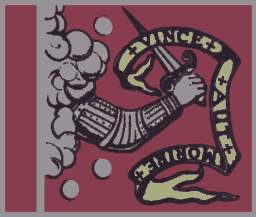
Bedford Flag- 1720’s
Until recently, considered the oldest flag in the United States, the Bedford Flag has been inspected by many experts and dated with great certainty to the first half of the 18th century. It is now on display at the Bedford Massachusetts Free Public Library. The flag was first used by a mounted militia unit, then carried at the time of the French and Indian War and finally taken into battle at the Concord Bridge in April of 1775.
On the open fields of Europe, military flags were essential not only to identify units but for communicating orders through the noise of battle. In eastern North America’s thick woodlands, flags didn’t work as well for communication. Still, they were a source of identity for colonial militias. Flags were generally designed by the senior officer of a militia and carried by the junior officer, called the coronet.
In 1720, Nathaniel Page became the first of several generations of Pages to serve as militia coronet for what would become Bedford Massachusetts. It is likely he carried the Bedford Flag as part of a horse troop protecting against invading French and their native allies. His grandson, also Nathaniel, served briefly during the French and Indian War, but probably didn’t take the flag with him. In March of 1775, responding to the growing threat from British regulars in Boston, Bedford hastily organized a minuteman company. Not having time create a flag for the company, Nathaniel Page brought out the old Flag and carried it into battle at Concord.
British Regulars would have carried two flags, the Kings Colours and a regimental flag. Most likely every militia present brought their unit flag. The Bedford Flag remains the most well-known of the flags present in April of 1775.
Sources
Bedford Free Public Library. “Bedford Flag” Retrieved 28 March 2023 from https://www.bedfordlibrary.net/about/bedford-flag/
Bedford Minuteman. “Our History” Retrieved 24 March 2023 From https://bedfordminutemen.org/about-us/our-history/bedford-minutemen/
McDonald, Sharon. “The Bedford Flag Unfurled” pp. 8-12, 33-39, 57-58, 71-75 (1996) Bedford Public Library
National Army Museum. “Save the Colours” Retrieved 5 April 2023 from https://www.nam.ac.uk/explore/save-colours
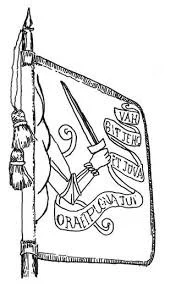
The Page Family, A Legacy of Service Carrying the Flag
Immigrating from England to North America, the Page family settled in Billerica Massachusetts in the 1680’s. The town consisted of some farms, a couple of mills, and a church. Nathaniel Page, the first in a long line of Nathaniel Pages, became a prosperous farmer. Dying suddenly, he left a wife and four children. Contrary to the custom of the time, Joanna his widow, never remarried. The farm, known as Mrs. Page’s Farm, became even more profitable.
From the late 17th century to the mid 18th century a series of European wars spilled over to involve North American colonies. Colonies relied on reserve militias for defense. Men aged 16-60 were required to drill regularly and serve when needed to protect their town. Militias carried flags for identification. Flags were created and owned by the senior officer. The junior officer, called the cornet, carried and protected the flag, with his life if necessary.
By 1706, Nathaniel Page II was part of a mounted troop. These troops were more elite than foot soldiers and came from the well to do. In 1720, town records refer to him as Cornet Page, a title he would have the rest of his life and beyond; his gravestone reads “the body of Cornet Nathaniel Page”. Cornet Page likely carried the Bedford Flag.
Being too difficult for some families to get to church in Billerica during the winter, Bedford was founded in 1729. Cornet Page helped build the new church and find the first pastor.
Two of Cornet Page’s sons were also commissioned as cornets. Bedford Town records refer to Nathaniel Page Jr. as Cornet Nathaniel Page Jr. in 1738. A year earlier, his brother John was commissioned as cornet in a county wide horse regiment. His commissioning document is on display at the Bradford Free Public Library. Both served as reservists during the final French and Indian War, but neither were called to active duty. Their uncle, Christopher Page served as a sergeant in the in the provincial army at the beginning of that war.
Towards the end of that final French and Indian War, known in Europe as the Seven Years War, Nathaniel Page, son of Cornet John Page, served an uneventful eight-month active duty tour guarding the fort at Crown Point, New York.
In the years following the war, relations between England and her North American colonies deteriorated. By March of 1775, concern regarding threat from the British Army occupying Boston compelled Bedford to establish a rapid response Minuteman company. Given his previous military experience, Nathaniel Page was chosen for the company. Having no time to make a new unit flag, Nathaniel Page pulled out an old flag once carried by his grandfather. The rest, as they say, is history.
The story of the Page family is the story of so many American families. They arrived as immigrants. Through hard work and determination, they built a life for themselves and in doing so build a nation.
Sources
McDonald, Sharon. “The Bedford Flag Unfurled” Ch. 4-6, 8-11 (1996) Bedford Free Public Library
Society of Colonial Wars in Massachusetts. “Timeline” Retrieved 11 April 2023 from https://www.scwma.org/research-aids/#1628100755376-1148fc2f-3d78
Very special thank you to Sharon Lawrence McDonald, librarian at Bedford Free Public Library, for introducing the Page family to us all.