New Years Day
January 1st
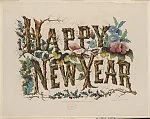
Currier & Ives. Happy New Year. , ca. 1876. New York: Published by Currier & Ives. Photograph. https://www.loc.gov/item/2002695831/.
Up until the beginning of the last century, January 1st was almost entirely a religious holiday. In colonial America, January 1st was rolled into the 12 Days of Christmas feasting. Considering the start of a new year as a good time for renewing one’s covenant with God, Charles Wesley, founder of the Methodist Church, began holding Covenant Renewal Services on New Year’s Eve in 1755. Also dating to colonial times, the custom in New York city was to gather at Trinity Church to “ring in the new year” with church bells and sing along to hymns and patriotic songs.
Taking effect at midnight December 31st 1862, the Emancipation Proclamation freed slaves held in the Confederate south. Slaves sat up all night singing hymns, praising God and waiting for their freedom. The tradition of praising God and praying on New Year’s Eve continues in many churches.
The first Tournament of Roses Parade was held on January 1st 1890 to promote Pasadena’s warm winter climate. The parade is held every January 1st, unless the 1st falls on a Sunday, then the parade is held on the 2nd, so as not to interfere with church services.
When the New York Times moved its headquarters to what is now Times Square in 1904, the newspaper celebrated with a huge New Year’s Eve party which included fireworks. Sparks raining down on revelers and closely crowded wooden buildings of New York became unsafe, so in 1907, an iron and wood ball was lowered. The ball has drop every New Year’s Eve since, except 1942 and 1943, when a moment of silence was observed for those who made the ultimate sacrifice in WW II.
In 1870 New Years Day became one of the first four federal holidays and was named a Flag holiday in 1923.