National Korean War Veterans Armistice Day
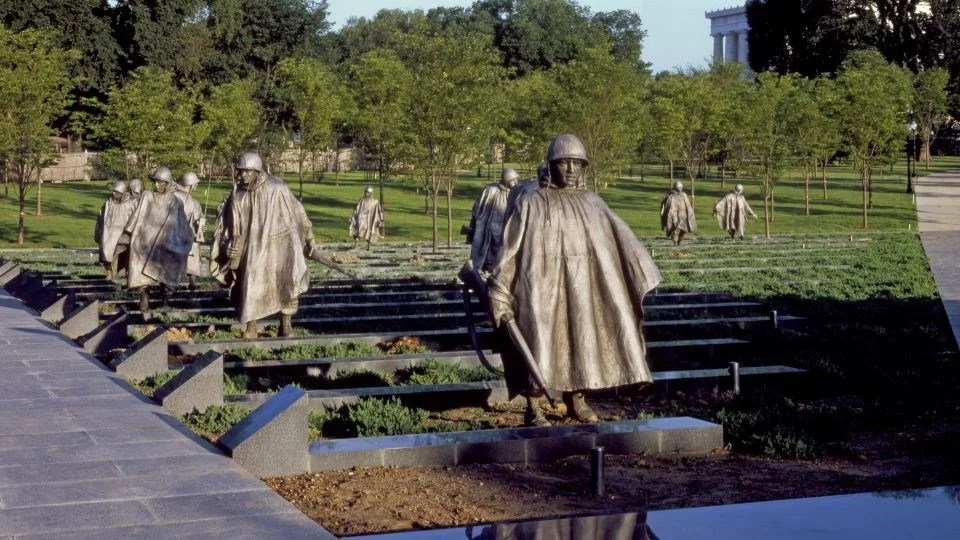
On Patrol NPS Photo
Following the collapse of the Japanese Empire, the Korean peninsula, which had been occupied by Japan since 1910, was divided between the U.S. and Soviet Russia. The Soviets occupied the north while the U.S. occupied the south with the purpose of establishing a stable government.
With the U.S. being focused on rebuilding Japan and the Philippians, the North Korean leader felt the time had come to unite Korea by force. On 25 June 1950, the Soviet armed and trained North Korean army poured south, nearly pushing the South Korean army and small U.S. contingent off the peninsula
The newly formed United Nations (U.N.) issued Resolution 82, condemning the invasion and establishing a united command with the U.S. taking the lead over troops from 22 nations. Unwilling to admit the U.N. had failed to prevent war or to ask Congress for a formal declaration, President Truman referred to the Korean War as a “police action”.
In September 1950, General MacArthur lead the largest amphibious landing since WWII at Inchon. The North Korean forces were pushed back to the mountains on the boarder with China. With the U.S. heavily involved, the Soviets refused to send troops, the war was all but over, and MacArthur promised the troops they would “be home by Christmas.”
Then in November of 1950, China entered the war. Poorly armed and poorly trained, they overwhelmed U.N. forces by shear numbers. Chinese causalities were nearly three times that of the U.N., but they just kept coming. General MacArthur advocated a full- scale invasion of China, others suggested dropping an atomic bomb. Wanting to avoid WWIII, President Truman replaced MacArthur with General Ridgeway and fighting continued with both sides gaining and losing ground over and over.
On 27 July 1953, an armistice agreement was signed ending hostilities and putting the line between North and South Korea where it was before the war. An official peace treaty was never signed and the Korean Demilitarized Zone remains one of the most heavily armed and dangerous boarded in the world. Since the war, South Korea has become one of the most prosperous nations in Asia while North Korea remains one of the poorest.
Often called the “forgotten war”, the Korean War is overlooked as just part of the Cold War. Nearly 6 million Americans served in the Korean War, with more than 36,000 making the ultimate sacrifice and more than 8000 still missing.
Dedicated on 27 July 1995, the Korean Veterans Memorial in Washington D.C. helps remember the forgotten. Signed in 2009, the Korean War Veterans Recognition Act made Korean War Veterans Armistice Day a flag holiday.