Constitution Day
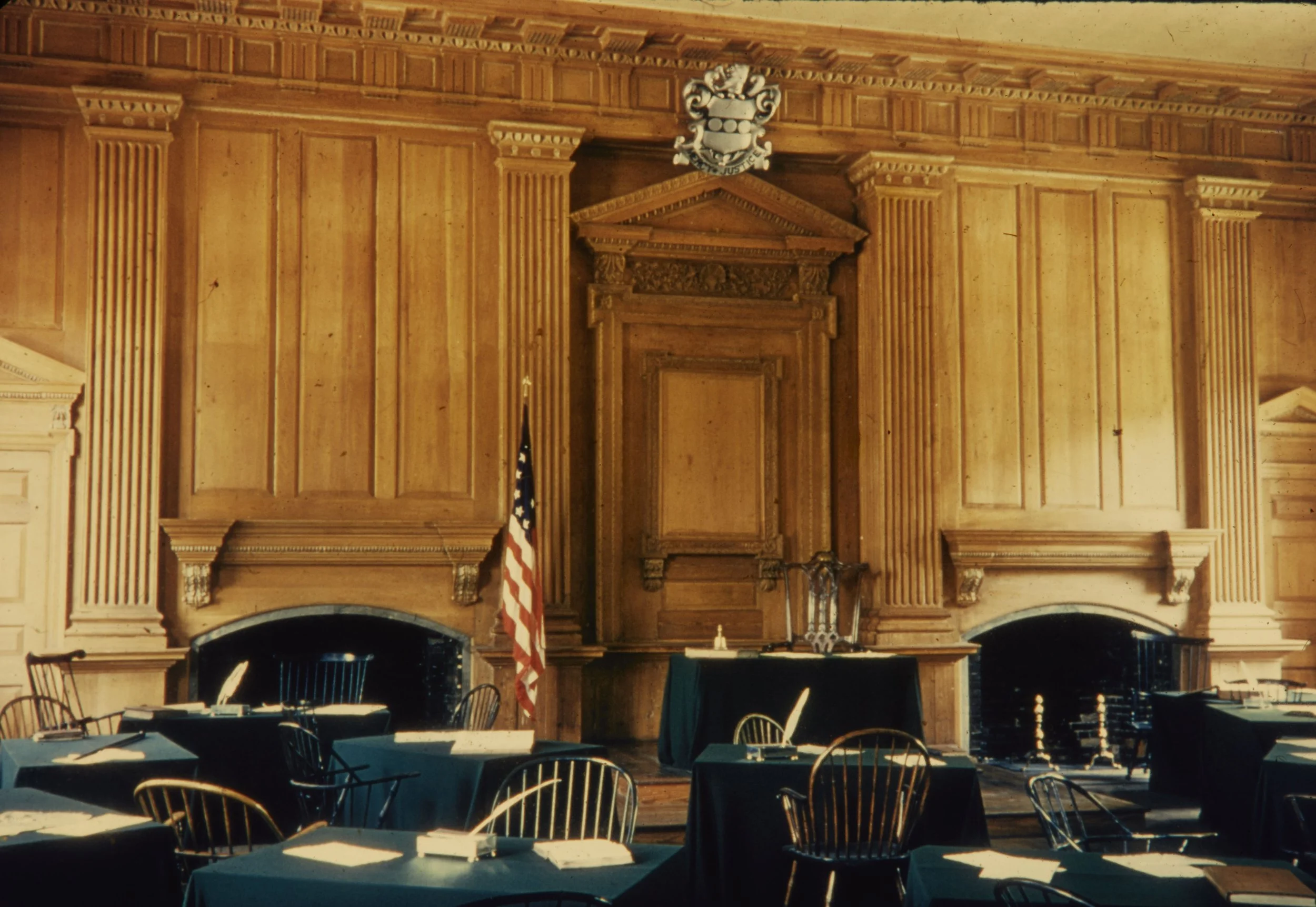
National Parks Service Photo
Less than five years after gaining independence, the United States of America were on the verge of collapse. The Articles of Confederation, under which the nation had operated since the Revolution, left the states more as 13 individual countries than as united states. They printed their own money and attempted to make their own foreign trade deals. Revolutionary War veterans, who went unpaid, returned to their farms deeply in debt. States struggling to pay off war debts raised taxes and confiscated the land of anyone who couldn’t pay. In May of 1787, 55 delegates met in Philadelphia to find a solution.
One of the few things they agreed on was having George Washington preside over the convention. In order to avoid outside influence, the delegates agreed to keep the discussion secret.
On 28 May, Edmond Randolph introduced a proposal written by James Madison, known as the Virginia Plan. The 15-point plan suggested a new idea for a government consisting of three branches, executive, legislative, and judiciary, each checking and balancing the other. The legislature would be divided into two parts, with representation based on state population. Under this plan, laws made by states could be overturned by the federal government.
Alarmed by the amount of power given to larger states by the Virginia Plan, the smaller states countered with a proposal which became known as the New Jersey Plan. This 11-point plan called for a three-branch government with the legislative branch having one part in which each state would be equally represented, and states would have more authority than the federal government.
Roger Sherman proposed a Great Compromise; a legislature of two houses, one in which all states have equal representation, and one having representation based on population. The Union was saved, for the moment.
Argument continued over the Executive Branch. Fearing a monarchy, some delegates suggested a tribunal, but others pointed out Rome tried that twice, with disastrous results. The delegates voted 60 times on how to select the Executive. Many wanted the people to choose, but in the days before internet and TV, it would be impossible for the people be sufficiently informed of each candidate’s character. Others wanted the Legislators to choose, but this would weaken the Executive’s ability to check the Legislature. Some said state governments should choose, but this would upset the balance between state and federal government. The delegates finally decided on a single executive elected by an Electoral College, based on legislative representation. Each state could decide how to designate their electoral votes.
The delegates agreed to end the import of slaves but left the practice of slavery intact. By 1787, five states banned, or were taking steps to ban slavery. Other northern states would soon follow, but in the south where the economy depended on bulk labor, it continued. Some delegates wanted a plan to abolish slavery, while others threatened to pull their states from the Union if slavery ended. Sothern states wanted slaves counted for representation, but not for taxation. Finally, a plan to count three slaves for every five was approved. The Union was saved, but at a price that would be paid by nearly 700,000 Americans 75 years later.
The Constitution came into existence as a flawed document, but it was a starting point. The great feature of the Constitution is it can be amended and has been updated 27 times. The United States Constitution is the oldest document of its type and has served as the bases for constitutions around the world.
The Constitution was signed by 38 delegates on 17 September 1787. It took nearly three years and the addition of a Bill of Rights for all 13 states to ratify the Constitution.
In 1952, President Truman proclaimed 17 September Citizenship Day to commemorate the signing of the Constitution and recognize all who attained citizenship. In 1955, President Eisenhower named the week of 17 September ConstitutionWeek. Although not a federal holiday, the day is recognized in the Flag Code as a day to display the Flag and is an important dayin our Nation’s history.