Christmas
Day
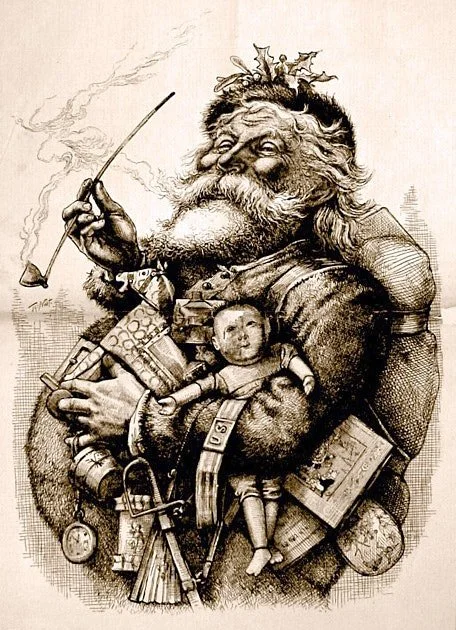
Nast, Thomas, Artist. Illustrations and political cartoons by Thomas Nast. United States, 1861. to 1886. Photograph. https://www.loc.gov/item/2010651579/.
The first recorded Christmas Eve services in North America were held in 1565 in St. Augustine, Fl. Captain John Smith wrote about Christmas in Jamestown in 1607. At Plymouth Colony, differences of opinion on how to celebrate the holiday lead to tensions.
With the exception of New England Puritans, who seemed to live in constant fear of having too much fun, Christmas was widely celebrated in colonial North America. In New Amsterdam (New York), where Christmas celebrating lasted from December 6th through New Year’s, children left shoes out for St. Nicholas to fill with toys. In New Mexico and California, Spanish speaking colonists reenacted Mary and Joseph's search for shelter. In Virginia, four weeks of Advent, spent in prayer, reflection, and fasting were followed by 12 days of dining, dancing, and good old all-American over consumption. Even the usually reserved Pennsylvania Quakers, who did not observe holidays because every day is holy, succumbed to the Spirit of the Day, decorating their homes and hosting Christmas dinners.
After the Revolution, some Americans passed on Christmas, thinking it was too British. George Washington however, hosted huge, all day celebrations at Mt. Vernon. As First Lady, Martha Washington hosted the members of Congress for Christmas dinner. The Adams celebrated the first Christmas in the White House. Abigail's dinner invitations are sometimes considered to be the first White House Christmas cards.
The American Christmas we know today really took shape during the 19th Century. In his 1832 poem "A Visit from St. Nicolas", New Yorker Clement Moore combined stories and legends about a 4th century Christian leader to present a true American icon of the season.
There is some debate over which President had the first Christmas tree. The earliest possibly being President Tyler in the mid 1840's. What is not in debate is that by the middle of the 19th century these evergreens of light had become a symbol of the American Christmas. There is an account of Civil War soldiers decorating a tree with the only thing they had; hardtack. To solve the dangers of mixing trees and candles, in 1882 American inventor Edward Johnson created electric Christmas lights.
In the 1920's and 30's, three traditions made New York (New Amsterdam) the center of the American Christmas. Appearing in 1924 and featuring Santa Claus, Macy's Thanksgiving Day Parade once signaled the start of the Christmas gift buying season. The Radio City Christmas Spectacular has ended every show, since its start in 1933, with the world's most spectacular living Nativity. In 1931, workers building the Rockefeller Center put up a 20' Christmas tree decorated with homemade ornaments. Referred to as a "true symbol of Christmas" this year’s tree is over 70' tall.
During the 20th century, American service members frequently needed to be away from home at Christmas to protect freedom and democracy around the world. Popular songs like "I'll be Home for Christmas" and "I'm Dreaming of a White Christmas" capture the longing to be home Americans feel at this time of year. It has become customary for Presidents to thank the troops for their sacrifice during the annual Christmas address.
Christmas is an important American holiday. Approved by Congress in 1870, Christmas was one of the first federal holidays. It is listed in the Flag Code as a day to display the American Flag.